
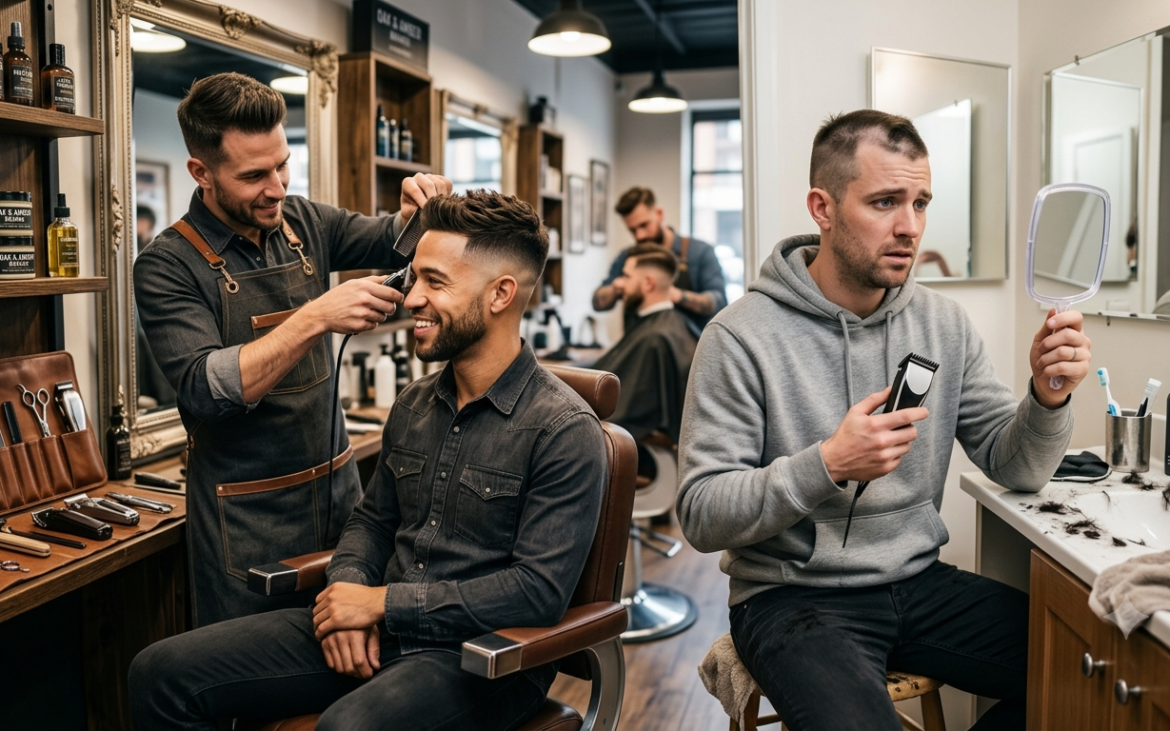
While DIY hair clippers and home haircut tutorials gained popularity in recent years, anyone who has attempted a home haircut knows the results rarely match a visit to a skilled professional.
Achieving a clean blend, sharp necklines, and a balanced silhouette requires far more than steady hands and a set of guard attachments. Here is a breakdown of why professional barbers consistently deliver superior results compared to home haircuts.
1. Ergonomics, Angles, and Blind Spots
The most obvious disadvantage of cutting your own hair is spatial perspective.
- The 360-Degree Angle: A barber stands above and around your head, viewing your skull structure, hair growth patterns, and symmetry from every angle in proper lighting.
- Mirror Misconceptions: At home, you rely on a bathroom mirror and a handheld mirror. Working through a double reflection reverses your hand movements, making precise clipper work, cross-checking layers, and lining up the back of the neck extraordinarily difficult.
- Dominant Hand Limitations: Attempting to cut or blend the side of your head opposite your dominant hand forces awkward wrist angles, leading to uneven pressure and inconsistent length drops.
2. Mastery of Hair Texture, Density, and Growth Patterns
Hair does not grow evenly across the scalp. Professional barbers spend years learning how to adapt their techniques to unique hair characteristics:
- Handling Cowlicks & Whorls: Hair grows in varying directions, particularly around the crown and nape. Barbers know how to cut with or across growth patterns to keep hair lying flat rather than sticking out.
- Managing Density Hotspots: Most people have thicker hair behind the ears and at the occipital bone. Barbers use thinning shears, point-cutting, and specific guard transitions to remove bulk without creating holes in the haircut.
- Head Shape Accommodation: Skulls have natural bumps, ridges, and flat spots. A professional tailors the weight line of the haircut to compensate for your specific head shape, creating the illusion of a perfectly symmetrical head.
3. Commercial-Grade Equipment vs. Consumer Tools
There is a vast difference between consumer-grade home grooming kits and the specialized tools found at a professional barber station:
+-----------------------------------------------------------------+
|                    TOOL PERFORMANCE GAP                         |
|                                                                 |
|  [ Consumer Trimmers ]  ---> Weak motors, tugging, thick blades  |
|  [ Barber Tools ]      ---> Rotary motors, zero-gapped blades   |
+-----------------------------------------------------------------+
| Feature | Consumer Home Clippers | Professional Barber Tools |
| Motor Power | Magnetic/Pivot motors (prone to snagging on thick hair) | High-torque Rotary/Brushless motors (smooth, constant blade speed) |
| Blade Precision | Stamped steel; wider teeth spacing | Japanese steel, DLC, or Titanium; micro-adjustable / zero-gapped |
| Shears / Scissors | Basic stainless steel craft/bevel shears | Forged Japanese cobalt steel convex-edge shears for crisp slicing |
| Detailing | Standard plastic guards | Micro-taper levers, foil shavers, and straight razors for skin-close finishes |
4. Advanced Technical Skills: Fading, Tapering, and Shear Work
A great haircut relies on techniques that take hundreds of hours of practice to master:
The Art of the Fade
Creating a seamless blend from skin to longer hair requires precise lever manipulation (open, half, closed) combined with a controlled “flicking” wrist motion. At home, attempts to fade often result in harsh line demarcation or pushing the blend line too high.
Shear-Over-Comb & Clipper-Over-Comb
To blend the shorter sides into longer top hair without leaving a ledge, barbers use over-comb techniques. This requires free-hand control and muscle memory that cannot be replicated easily on oneself.
Scissor Control & Sectioning
Professional haircuts rely on systematic sectioning, elevation angles, and finger placement. Barbers cut hair relative to the head’s curvature to ensure that as the hair grows out over 3 to 4 weeks, it retains its structure and shape.
5. Clean Lines, Neckline Craft, and Finishing Touches
The hallmark of a fresh haircut is in the details.
A barber finishes every cut by crisping up the hairline, cleaning the neck with a straight razor or foil shaver, and trimming stray hairs around the ears. Attempting to line up your own neckline behind your back almost always leads to a crooked line or taking the neckline up too high—a mistake that takes weeks to grow back out.
The Verdict
While home touch-ups can work in a pinch for simple single-guard buzz cuts, a professional haircut is an investment in personal presentation, skill, and symmetry. A master barber does not just shorten your hair—they sculpt it to complement your face shape, head structure, and personal style.